
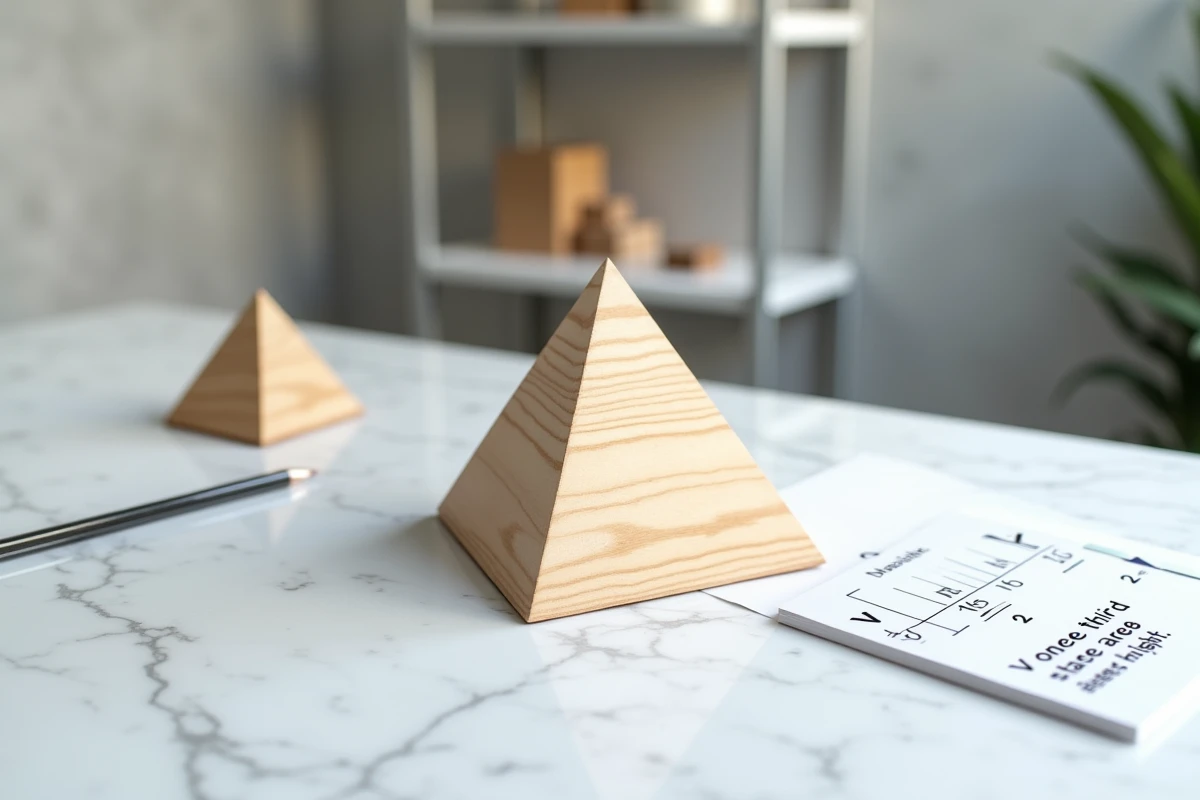
The formula V = (1/3) x Area of the base x height poses no difficulty as long as each quantity is correctly identified. The calculation of the volume of a pyramid with a triangular base rarely stumbles on algebra: it is the geometric interpretation of the solid that generates errors. Here, we detail the technical points that most public resources gloss over.
Height of the pyramid and apothem: the confusion that skews the volume
The first documented source of error concerns the distinction between three segments that are often confused: the perpendicular height of the pyramid, the apothem of a lateral face, and the length of a lateral edge. The report from the General Inspection (IGÉSR, DNB 2023 report, published in 2024) explicitly notes a significant increase in this confusion in exam papers regarding the volumes of pyramids, including those with a triangular base.
Related reading : What is the principle of a SCPI?
The height of the pyramid is the segment that connects the apex to the base plane, forming a right angle with this plane. In a right pyramid, the foot of this height coincides with the center of the base. In an oblique pyramid, this foot falls outside the center, sometimes even outside the base triangle.
The apothem of a lateral face, on the other hand, is the height of a lateral triangle drawn from the apex of the pyramid to the corresponding side of the base. This segment is always longer than the height of the pyramid as long as the pyramid is not degenerate. Using the apothem instead of the height leads to a systematic overestimation of the volume.
Read also : How to Reduce the Cost of a Blood Test: 5 Tips to Pay Less!
To isolate the height when the statement does not provide it directly, we recommend applying the Pythagorean theorem in the right triangle formed by the height, the distance from the center of the base to the midpoint of one side, and the apothem of the lateral face. This assumes prior knowledge of the position of the foot of the height, which brings us back to the geometry of the base triangle.
Those who wish to delve deeper into the complete process can refer to a guide that explains how to find the volume of a triangular-based pyramid by detailing each step with diagrams.

Area of any triangular base: do not limit to the equilateral case
Many educational examples choose an equilateral or right triangle as the base, which simplifies the area calculation. This habit creates a bias: when faced with a scalene or obtuse triangle, the reflex of half the base times height is no longer sufficient if one does not know how to draw the height relative to the correct side.
The formula V = (1/3) x Area(base) x h is independent of the type of triangle serving as the base. Whether the triangle is right, isosceles, equilateral, or scalene, only the area matters. The Geometry 2de textbook from Nathan (2023 edition) emphasizes this point.
Three methods to calculate the area of any triangle
- Half the base times the relative height: A = (1/2) x b x h_b, where h_b is the height drawn perpendicular to side b. Direct method when the height is given or measurable.
- Heron’s formula: A = sqrt(s(s-a)(s-b)(s-c)) with s = (a+b+c)/2. Works only from the three sides, without needing to know a height. Useful when only the lengths of the base edges are available.
- Vector product (coordinates): if the three vertices of the base are given in a coordinate system, the area is half the norm of the vector product of two side vectors. This approach eliminates any ambiguity about the height.
The choice of method depends on the data provided in the statement. In an exam context, checking the consistency of the obtained area with a quick bounding (the triangle fits within a rectangle whose area is double) helps detect a data entry error before proceeding to the volume.
Volume calculation: operational sequence and rounding errors
Once the area of the base (A_b) and the perpendicular height (h) are determined, the volume is obtained in a single operation:
V = A_b x h / 3
The order of operations is important on a calculator. Multiplying A_b by h first, then dividing by 3, avoids intermediate rounding that accumulates. Dividing h by 3 before multiplying by A_b introduces an additional rounding when h is not a multiple of 3.
Special case of the regular tetrahedron
When the four faces are equilateral triangles with side a, the volume has a compact formula: V = a³ x sqrt(2) / 12. This expression directly derives from the general formula but spares the separate calculation of the area of the base and the height. We frequently use it in modeling to validate a volumetric calculation algorithm on a reference solid whose analytical result is known.
For an irregular tetrahedron with known six edges, the Cayley-Menger formula (5×5 determinant of squared distances) provides the volume without needing to identify base and height. This approach goes beyond the school framework but is standard in computational geometry.
Dimensional verification and unit traps
A check that we systematically perform: dimensional analysis of the result. The area of the base is expressed in square units, the height in linear units. Their product divided by 3 indeed gives cubic units. If the statement mixes centimeters and meters, the result will be wrong by a factor that can reach a million.
- Convert all measurements to the same unit before any calculation.
- Express the final result in the corresponding cubic unit (cm³, m³, etc.).
- Compare the obtained volume to a known order of magnitude: a regular tetrahedron with a side of 10 cm has a volume of about 117.85 cm³, which is just over a deciliter.
The volume of a triangular-based pyramid remains an accessible exercise as long as each geometric quantity is treated for what it is. Rigor lies less in the formula itself than in the correct identification of the height and the reliable calculation of the area of the base, two steps where nearly all errors concentrate.