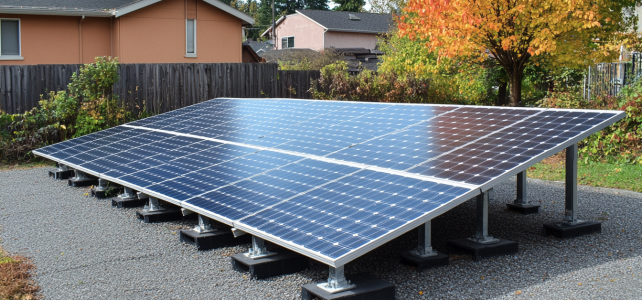
In a world beset by environmental challenges, solar panels stand out as a major player in the energy transition. By harnessing the inexhaustible energy of the sun, they provide a promising alternative to fossil fuel sources, thus helping to reduce our carbon footprint. Their installation, while requiring an initial investment, proves to be a long-term economical solution, promoting the energy independence of households and businesses. With technological advancements and increasing government incentives, solar energy has never been more accessible.
How Solar Panels Work
Solar panels operate on a simple yet ingenious principle, converting sunlight into usable electricity. This process relies on photovoltaic technology, a scientific breakthrough that has revolutionized our approach to energy production.
- Photovoltaic: Photovoltaic cells are the basic components. Made of semiconductor materials, they absorb solar photons and release electrons.
- Energy Conversion: The released electrons flow through a circuit, generating direct current. An inverter is then used to convert this current into alternating current, compatible with our domestic electrical grids.
- Storage: The electricity produced can be used immediately or stored in batteries for later use. This storage capability is crucial for addressing periods of low sunlight.
Environmental and Economic Benefits
The adoption of solar panels presents numerous benefits, both environmentally and economically. Their efficiency and durability make them a favored solution among a growing number of people worldwide.
Environmentally, solar energy is renewable and clean. It produces virtually no greenhouse gases, making it ideal for combating climate change. Furthermore, solar energy reduces our dependence on fossil fuels, which are both polluting and depleting.
Economically, after the initial investment, solar panels lead to significant savings on electricity bills. Many governments offer financial incentives to encourage their adoption. This includes tax credits, grants, and favorable feed-in tariffs for excess electricity produced.
Current Challenges and Limitations
Despite its many advantages, solar energy faces challenges that still limit its large-scale adoption. These obstacles, although surmountable, require particular attention to better integrate this technology into our daily lives.
- Initial Cost: The installation price remains high, although costs have decreased in recent years.
- Sunlight Availability: The performance of the panels depends on sunlight, which can be an issue in less sunny regions.
- Energy Storage: Storage remains costly, and current solutions are not always optimal for large scales.
- Environmental Impact: The manufacturing of panels involves a significant use of resources and energy.
Technological Innovations and Future Perspectives
Technological advancements promise to overcome the current limitations of solar panels. Investigating these new approaches is essential to understand how they can transform our energy landscape.
Bifacial technologies allow capturing light from both sides of the panel, thus increasing efficiency. Organic solar panels, still in the experimental stage, could offer more flexible and less costly production solutions. Additionally, the development of innovative materials like perovskite presents exciting prospects for the future of solar energy.
Researchers are also striving to improve storage technologies. Lithium-ion batteries continue to evolve, and other solutions like compressed air storage or hydrogen storage are beginning to emerge.
As technological innovations continue to progress, solar panels are establishing themselves as an essential solution for a sustainable energy future. They represent not only a technological advancement but also a commitment to a greener and cleaner planet, where renewable energy is at the heart of our concerns. Beyond their technical aspect, they symbolize a shift in mindset, a step towards a world where humanity coexists harmoniously with its environment.