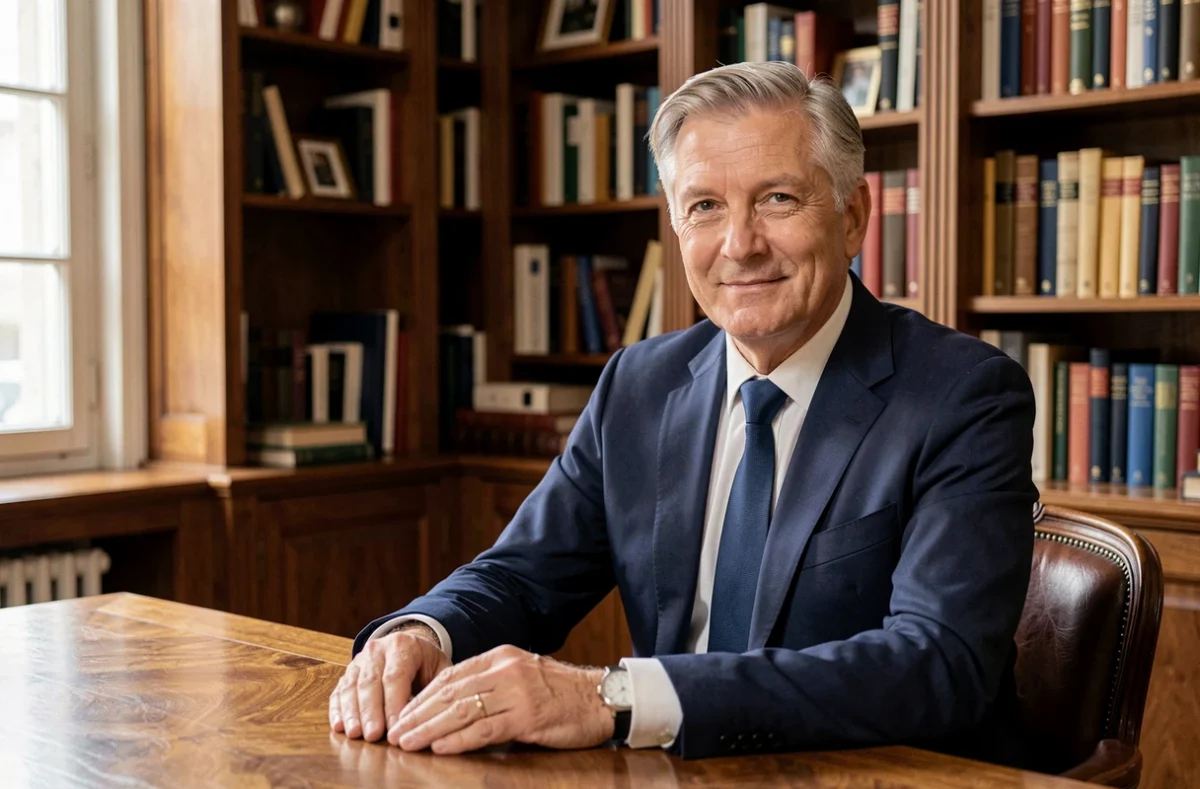
Marc de Chalvron is one of the recurring faces of international news on France 2. A war correspondent and senior reporter, he regularly appears from conflict or crisis zones. However, the query “Marc de Chalvron private life” consistently resurfaces in search engines. The observation is clear: no verifiable journalistic source documents his romantic life, marital status, or any potential fatherhood.
Marc de Chalvron and the podcast “Au comptoir de l’info”: when the reporter talks about himself without revealing anything
Interviews where Marc de Chalvron speaks in the first person do exist. In the podcast “Au comptoir de l’info,” he reflected on a trench report in Ukraine, under bombardment, and on a moment of doubt where he considered not continuing.
This type of speaking blurs the usual boundaries. The journalist shares a form of professional intimacy (fear, fatigue, hesitation) without ever opening the door to his personal life. For those seeking details about Marc de Chalvron’s private life, the distinction is frustrating but intentional.
The field reports he shares focus on Sudan, Ukraine, and the Sahel. They describe access constraints, physical risks, and the limits of what a reporter can film or recount. No mention of a partner, a home, or children filters through these public exchanges.
Marc de Chalvron’s professional journey: the positions that explain his discretion
Reducing Marc de Chalvron to the role of “war reporter” simplifies a more complex trajectory. Verifiable sources trace steps at France 24 as a correspondent in Jerusalem, then a stint at i-Télé and Canal+, before a position as a correspondent for France 2 in Dakar and integration into the “Investigations and Reports” service.
This permanent geographical mobility shapes a lifestyle incompatible with personal media exposure. A correspondent based successively in the Middle East, West Africa, and conflict zones does not frequent the same circles as a Parisian studio presenter.
The family dimension of journalism among the Chalvrons
The name Chalvron did not appear in the French media landscape with Marc. His father, Alain de Chalvron, was a special correspondent for France Télévisions for several decades.
This journalistic lineage has never led to tabloid treatment. Both father and son have maintained a clear separation between professional public life and private sphere. Point de Vue published an article about the family from the angle of “coat of arms and renown,” without revealing any sentimental elements.
Rumors about Marc de Chalvron’s private life: how they are manufactured
The mechanism is documented and reproducible. A television journalist benefits from strong visual notoriety. Internet users type his name followed by “wife,” “couple,” or “partner.” Search engines record these queries and suggest them automatically, amplifying the impression that information exists somewhere.
Aggregator sites exploit this search volume by publishing pages that rephrase the absence of data into optimized content. The structure is always the same:
- A title containing the journalist’s name and a relational keyword (“couple,” “wife,” “partner”)
- Several paragraphs that revolve around the subject without ever citing a verifiable source
- A conclusion that acknowledges, at the end of the page, that the information does not exist
This process generates traffic without producing any information. It feeds a loop where the query creates the content, and the content validates the query.
Confusion with other public figures sharing the name Chalvron
The surname “de Chalvron” also appears in political or diplomatic news, adding a layer of confusion. Cross-referenced searches sometimes mix results concerning Marc, his father Alain, or other family members. No reliable cross-checking allows attributing information related to a namesake or relative to Marc.
Field journalists and private life: a professional norm, not an anomaly
Marc de Chalvron’s discretion about his personal life is not an isolated case in major reporting. War correspondents and special envoys in conflict zones share a concrete constraint: publicly naming a loved one can turn them into a target or a leverage point.
This logic of protection goes beyond mere modesty. It is based on operational security considerations that reporters integrate from their first assignments. Marc de Chalvron himself mentioned, regarding Sudan, the limits of journalistic coverage in areas where access and security dictate what can be reported.
- The X accounts (formerly Twitter) attributed to Marc de Chalvron contain no personal publications
- The archives of reports broadcast on France 2 and in Envoyé spécial never mention his life off-camera
- Interviews in print media remain strictly confined to the profession and the covered fields
Silence is not a void to be filled but a professional boundary maintained over time. The only verifiable public elements concern his career, his reports, and the testimonies he provides about working conditions in hostile areas.
For anyone seeking revelations about Marc de Chalvron’s romantic life, the documented answer has remained the same since the beginning of his career: there are none. What is public is a reporter’s journey built between Jerusalem, Dakar, Ukraine, and the Sahel, and a rare voice, always brought back to the field.