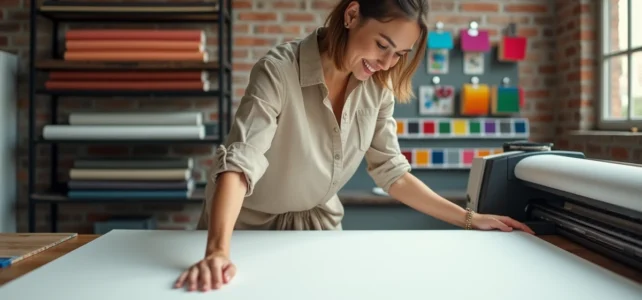
Custom printing is no longer limited to business cards and flyers. The market has expanded to textiles, promotional items, large-format signage, and custom packaging. This diversification of media is accompanied by technical developments that change the selection criteria for project holders, whether they are associations, businesses, or individuals.
Custom printing and certified inks: what the REACH regulation changes
The quality of custom printing is not judged solely by its visual appearance. Since 2023, several textile printers in France have been highlighting ranges of certified inks for non-toxicity, particularly through the OEKO-TEX Standard 100 and GOTS labels for direct-to-garment (DTG) printing.
You may also like : Discover all the essential resources to boost your IT skills
This orientation meets the strengthened requirements of the European REACH regulation on chemical substances in textile products intended for the general public. For projects involving clothing intended for children, these certifications are no longer a marketing argument: they condition access to certain markets and distribution channels.
The question of compliance also arises for printed promotional items (mugs, water bottles, notebooks). Clients ordering from a workshop like Orvinfait benefit from checking the technical data sheets of the inks used in advance, especially for items in contact with food.
See also : Discover the secrets of health insurance: your essential ally
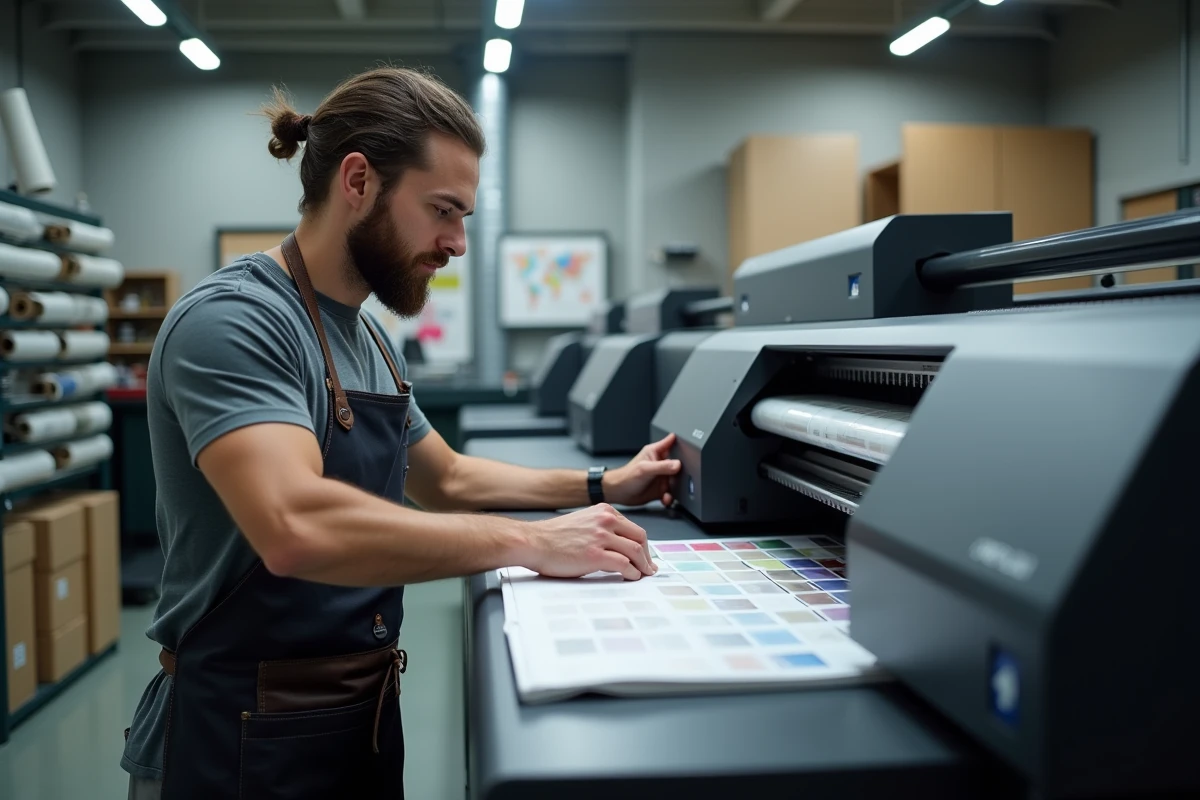
Screen printing, DTG, DTF transfer: choosing the right printing technique
The choice of printing technique determines the finish, durability, and unit cost of the finished product. The three most common processes in France cover distinct uses.
- Screen printing remains the reference process for large series on textiles. It offers superior opacity and wash resistance, but requires the creation of a screen for each color, making it less suitable for small quantities or four-color visuals.
- Direct-to-garment (DTG) printing allows for the reproduction of complex visuals, with gradients and an unlimited number of colors, directly on the fabric. It is suitable for short runs and prototypes; however, its unit cost increases little with quantity.
- DTF (direct-to-film) transfer positions itself between the two: a visual printed on film is then heat-pressed onto the textile. This process allows for various finishes (matte, glossy, glittery) and works on challenging substrates like polyester or dark textiles.
None of these techniques is universally superior. The right process depends on the substrate, volume, and level of detail of the visual. A promotional cotton t-shirt produced in several hundred copies calls for screen printing. A personalized sweatshirt with an employee’s name in a single copy falls under DTG.
The weight of the fabric, an underestimated parameter
The printing technique is only part of the equation. The weight and composition of the fabric directly influence ink absorption and the clarity of the marking. A lightweight cotton will yield a faded look in DTG, while a dense polyester may pose adhesion problems in traditional screen printing.
Requesting a sample before validating a series remains the most reliable method for assessing the final result. Field feedback varies on this point: some workshops offer free tests, while others charge for a textile proof (BAT).
Generative AI and visual creation for printing: state of play
Since 2023, French creative agencies like BETC and Artefact have been documenting the use of generative AI in creating custom printing visuals. The goal is not to replace the graphic designer, but to quickly produce several creative options (patterns, fonts, logo variations) that are then evaluated and refined by a human.
For project holders without a significant graphic budget, these tools change the game. A student office can generate a dozen visual proposals for a promotional sweatshirt in just a few minutes, then submit the best ones to their printer for technical adjustments.
However, the limitations remain real. The available data does not allow for conclusions about the consistent quality of AI-generated visuals once translated into print. Colors on screen do not always match the output on fabric or cardboard, and the resolution of files produced by some image generators remains insufficient for print formats larger than A3.

Onboarding kits and personalized textiles in companies: a documented HR lever
Custom printing finds an increasing outlet in human resources departments. Feedback shared by the ANDRH and the publication Entreprise & Carrières since 2022 indicates that onboarding kits including personalized items enhance the sense of belonging of new employees during their first six months.
These kits generally include a branded hoodie or t-shirt, a mug, a notebook printed with the employee’s name, and sometimes a tote bag in the company’s colors. The format and finishes vary according to the range chosen by the communications department.
What this implies for choosing a printer
An onboarding project imposes specific constraints: short deadlines, unit personalization, and consistent quality from one kit to another. The printer must be able to handle mixed series (textile + item + stationery) without multiplying intermediaries.
Printers positioned in this niche often offer a storage and on-demand shipping service: the company orders a kit for each new hire without having to manage physical stock. This just-in-time model assumes a production chain capable of processing unit orders with the same rigor as a series of several hundred pieces.
The custom printing market in France is structured around these intersecting requirements: regulatory compliance of inks, technical mastery of processes, ability to handle variable volumes, and integration of digital tools in the creation phase. The choice of a provider should be evaluated based on these concrete criteria rather than solely on the displayed unit price.