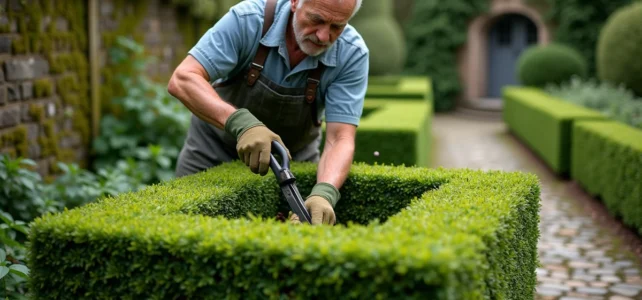
The artistic size of hedges relies on precise technical choices from the moment of planting. The plant, the initial framework, and the intervention schedule condition the result much more than the finishing gesture. Here we address the points that make the difference between a durable sculpted form and a topiary that degenerates in two seasons.
Framework and branching: the invisible work that precedes sculpture
A hedge intended for artistic pruning is prepared several years before the first decorative shears cut. The principle is to force dense branching from the base through short and repeated formative prunings, cutting back the shoots by one third at each intervention during the first two or three years.
Without this step, the plant develops a parasol shape with a bare trunk. No hedge trimmer, no matter how precise, can correct a hollow framework. We recommend pinching the tips with pruning shears rather than with a hedge trimmer during this phase, to control the direction of each twig.
The choice of species directly influences the complexity of the shapes that can be achieved. Yew (Taxus baccata) and boxwood (Buxus sempervirens) tolerate severe pruning and regenerate on old wood. Hornbeam (Carpinus betulus) accepts geometric shapes but does not handle tight curves well. Privet (Ligustrum) grows quickly, which necessitates more frequent interventions to maintain a clean profile. Resources like sculpte-haie.com detail the plant associations suitable for each type of sculpture.
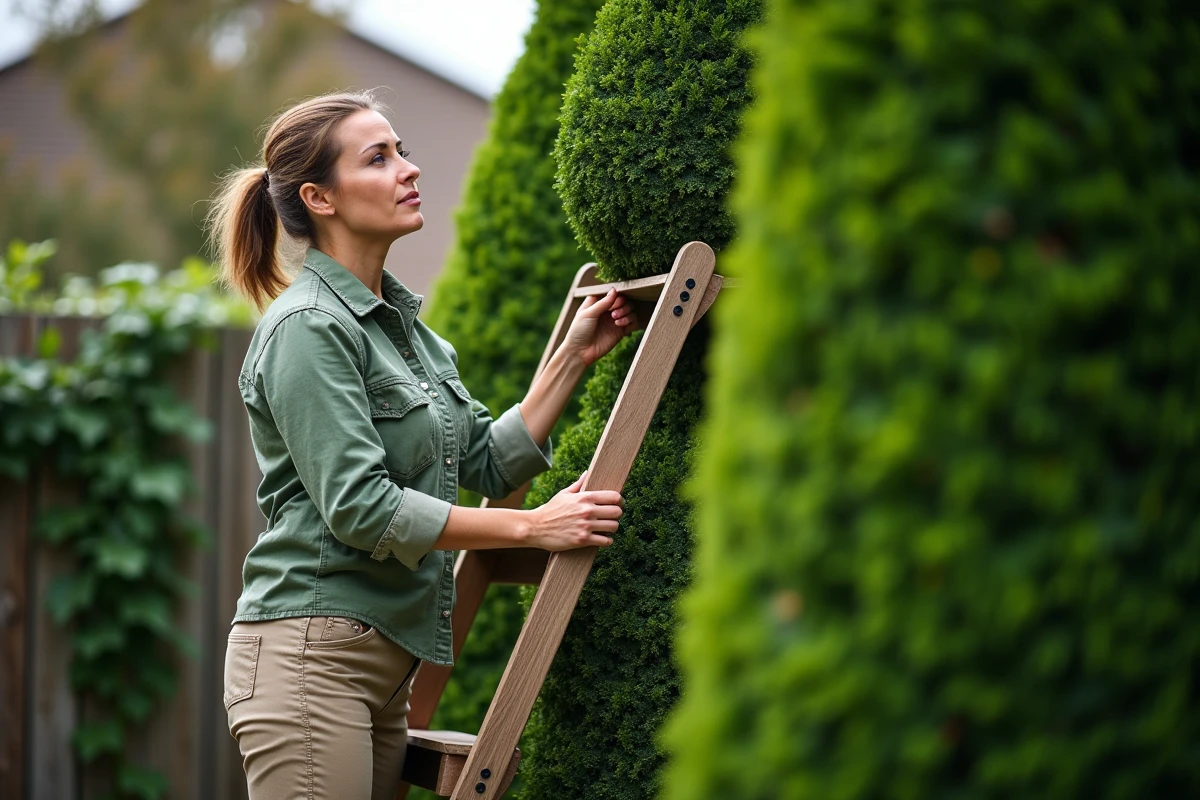
Topiary on hedge: geometry or free form, the constraints differ
The distinction between geometric topiary and free form is not just aesthetic. It determines the tools, maintenance frequency, and tolerance for error.
Geometric shapes: templates and cutting guides
Simple volumes (cube, sphere, pyramid) require rigid templates made of wire or wood. Pressing the template against the hedge and trimming flush with the guide remains the most reliable method. On a linear hedge, a taut string between two stakes ensures the horizontal alignment of the top.
A common mistake is to trim the top wider than the base. This inverted trapezoid shape deprives the lower branches of light. The base must always remain wider than the top, even by a few centimeters, to maintain vegetation throughout the height.
Free and figurative forms
Spirals, animals, or waves require progressive work through successive passes. We observe that beginners tend to cut too deeply in one session, creating visible gaps in vegetation for several months. It is better to make three light passes spaced a few weeks apart than one radical cut.
For complex shapes, a custom-formed welded wire mesh serves as a permanent framework. The plant grows through it, and pruning simply involves trimming what exceeds the mesh. This technique is common in professional topiary art.
Artistic pruning schedule: when to intervene according to species
The schedule depends on the biology of each shrub, but also on regulatory constraints. The LPO reminds us that the nesting period, generally from March to the end of July, requires checking for the absence of active nests before any intervention on a hedge. In artistic pruning, frequent interventions necessitate heightened vigilance.
- Yew and boxwood: main pruning in June after the first growth, touch-up in September. These slow-growing species tolerate maintenance limited to two annual passes.
- Hornbeam and beech: first pruning in June, second at the end of August. The marcescent foliage of hornbeam remains in place during winter, preserving the sculpted silhouette even in the cold season.
- Privet and laurel: a minimum of three interventions (May, July, September) to maintain a clean profile. Their vigor requires close monitoring but allows for quick corrections in case of clumsy cuts.
- Photinia and eleagnus: pruning after each growth wave, avoiding frost periods. Their naturally loose growth complicates very geometric shapes.
Pruning in overcast weather or at the end of the day reduces water stress and limits browning of the cut leaves, a visible defect for several weeks on species with large leaves.
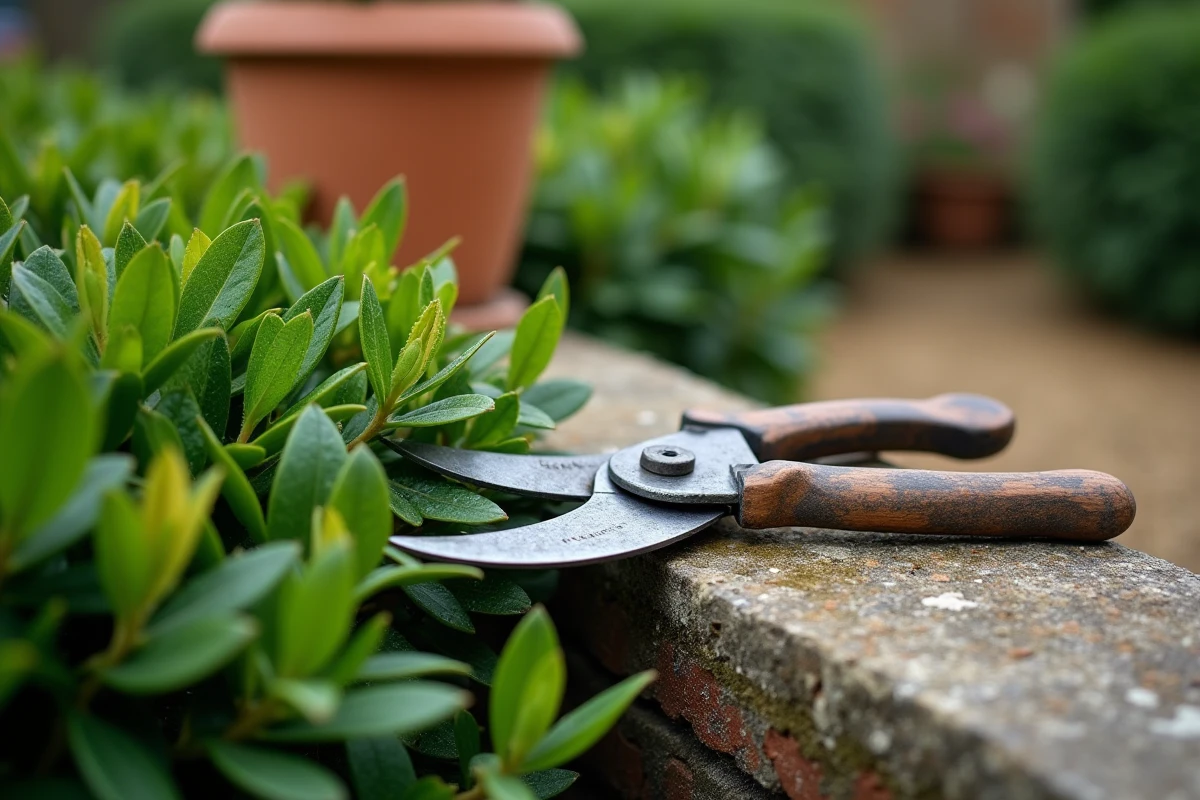
Precision pruning tools: short saber and low noise battery
Classic long-saber hedge trimmers are suitable for linear hedges but lack maneuverability for sculpture. A saber of 40 to 50 cm with a reduced stroke allows following curves without tearing adjacent twigs.
In recent years, battery ranges from STIHL (HSA series) and Husqvarna (36V Pro range) have integrated anti-vibration systems and quieter motors, two direct advantages for precision work. The low noise level also facilitates use in urban or shared gardens, where the noise from gas-powered engines is a recurring hindrance.
For finishing touches on boxwood and yew, manual hedge shears remain the reference tool. Manual cutting produces a clean section that heals better than a mechanical cut, limiting the entry of pathogens. On boxwood, this detail matters: a poorly healed wound promotes the fungus Cylindrocladium buxicola, responsible for boxwood decline.
Artistic pruning and biodiversity: adapting sculpture to living things
The recommendations stemming from the Climate and Resilience law and recent PLUs (Rennes Métropole, Gironde) encourage avoiding “wall-like” monotypic hedges at property boundaries. Alternating sculpted sections and areas left in semi-free growth meets this requirement while preserving decorative interest.
In practice, we recommend reserving artistic pruning for focal points (entrance, terrace corner, view framing) and leaving the rest of the hedge in a more natural shape. This approach also reduces maintenance load, as only the sculpted volumes require close monitoring.
Integrating berry-producing species (pyracantha, cotoneaster) into the hedge provides a food resource for birds without compromising the sculpture, as long as they are placed in the free sections. The visual contrast between trimmed volumes and flowering or fruiting masses often yields a more interesting result than a fully sculpted hedge.